
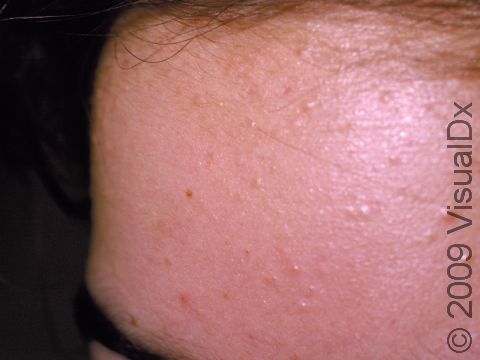
Whiteheads (closed comedones) are the earliest lesions of acne.
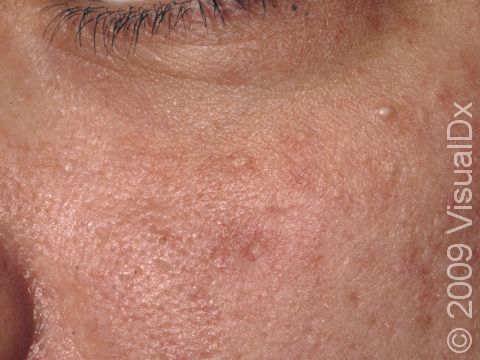
This image displays small, slightly elevated lesions and scars in an adult with chronic acne.
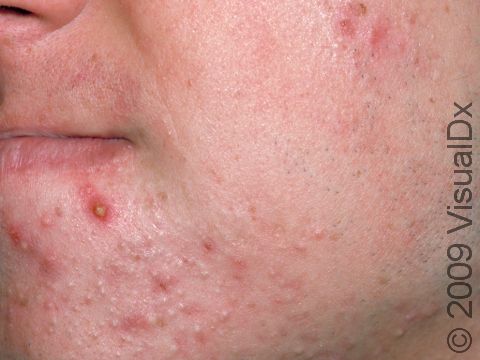
This image displays pus-filled lesions with whiteheads and blackheads (closed and open comedones) in an adult with moderate acne.
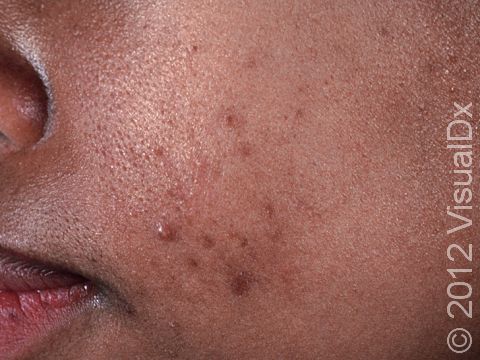
This image displays one raised acne lesion and several flat, dark spots from prior inflammation, which may take months to resolve due to the patient's darker skin.
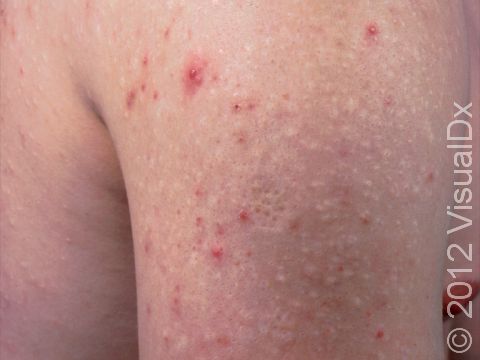
This image displays multiple light skin scars typical of persistent acne over years.
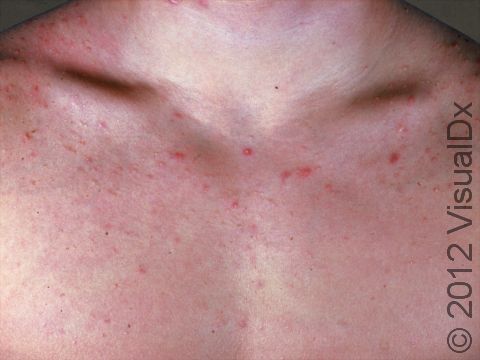
This image displays mild pus-filled lesions and bumps of acne on the chest.
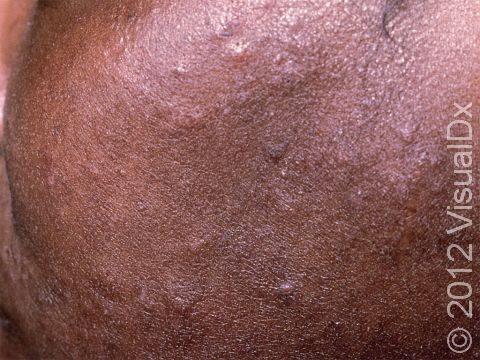
In people with darker skin, redness and inflammation of acne can be difficult to see.
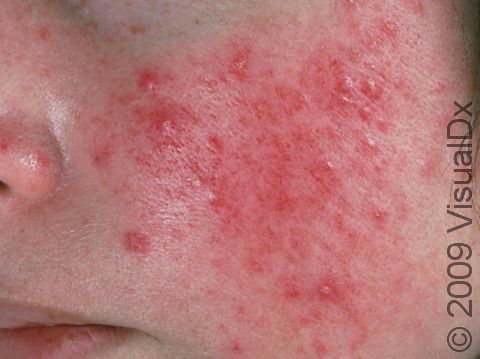
This image displays the overall redness of the cheeks with accompanying red bumps typical of inflammatory acne.
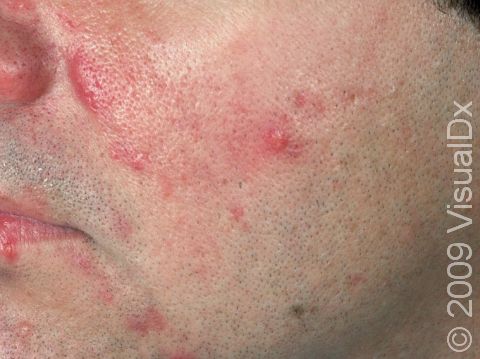
This image displays several large, inflamed bumps typical of acne vulgaris.
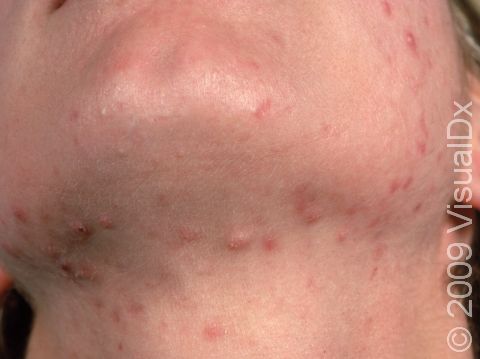
This image displays acne on the jaw line and neck.
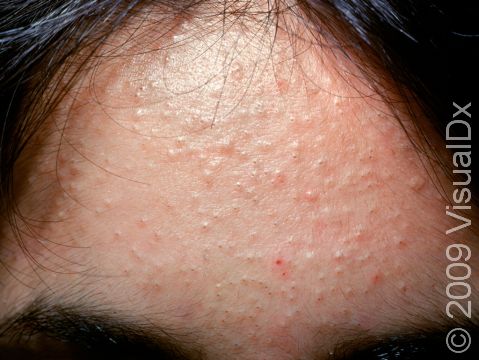
This image displays blackheads and whiteheads (open and closed comedones).
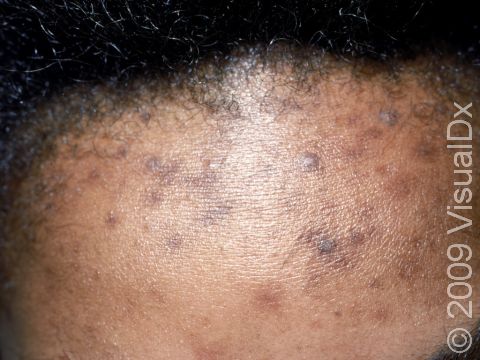
This image displays darker color (pigment) in areas that had acne previously, which takes longer to heal in people with darker skin.
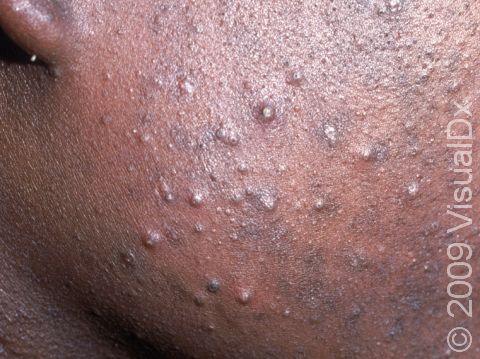
In Black patients, inflammatory lesions lead to unwanted dark spots, as displayed in this image.
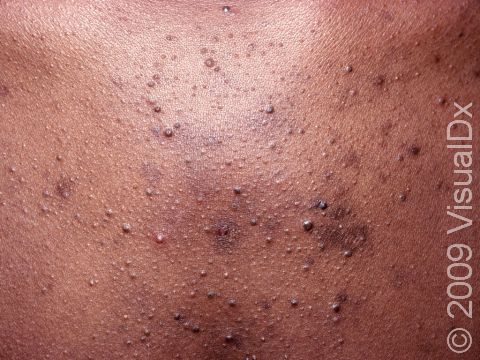
This image displays whiteheads (closed comedones) on the chest.
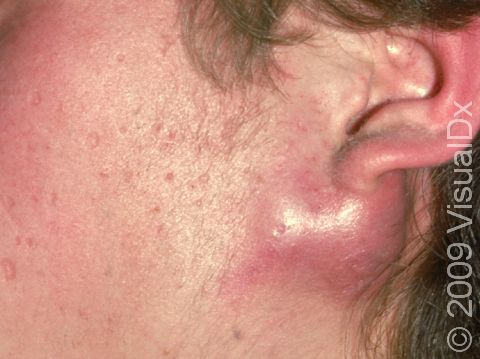
This image displays a large, inflamed acne cyst.
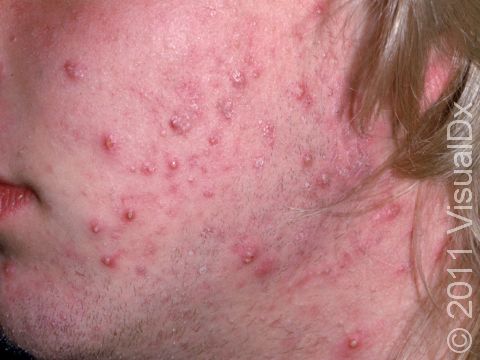
This image displays a mix of pus-filled and inflammatory acne.
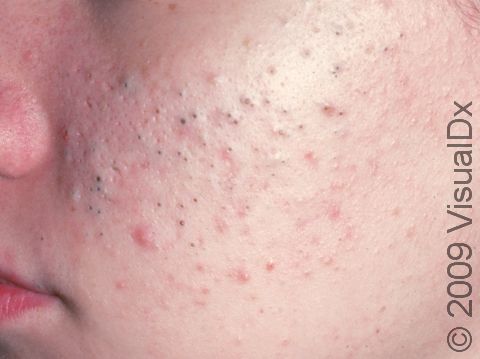
Blackheads (open comedones) are follicles plugged with scale and oil, as displayed in this image.
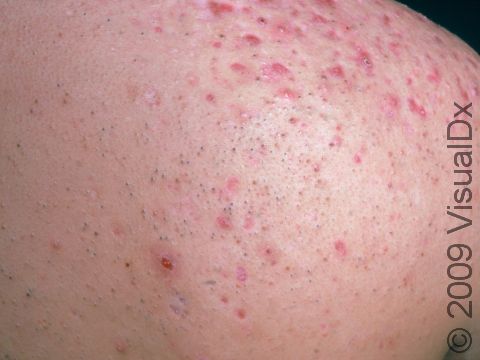
This image displays a mix of blackheads (open comedones), red bumps, and depressed scars typical of acne vulgaris.
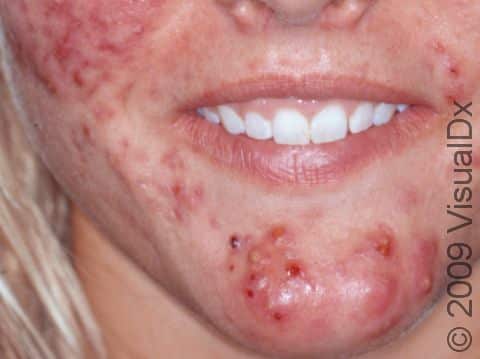
This image displays severe cystic acne.
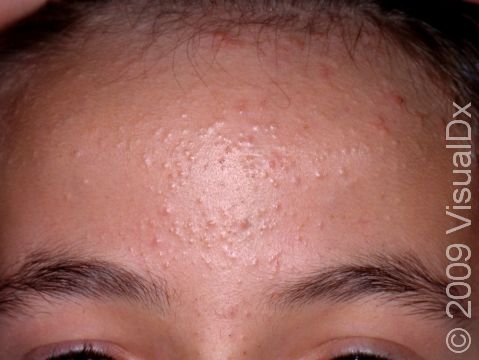
This image displays whiteheads and blackheads (open and closed comedones) on the forehead.
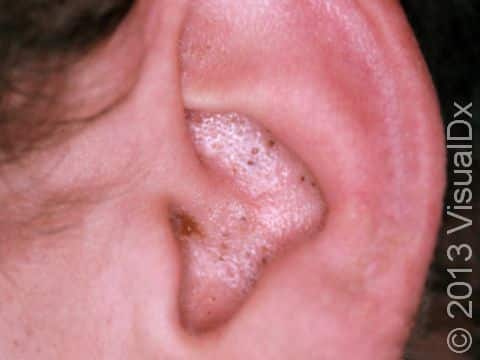
This image displays blackheads (open comedones) in the ear area typical of acne.
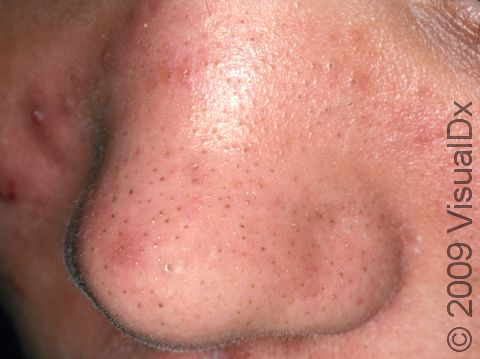
Multiple "blackheads" (open comedones) as well as a few red, inflammatory bumps are seen here on the nose.
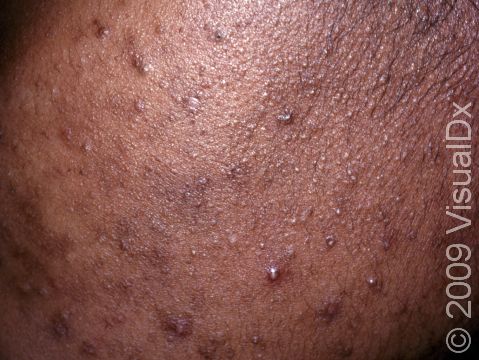
This image displays pus-filled lesions and blackheads (open comedones), as well as darkened areas from previous acne lesions.
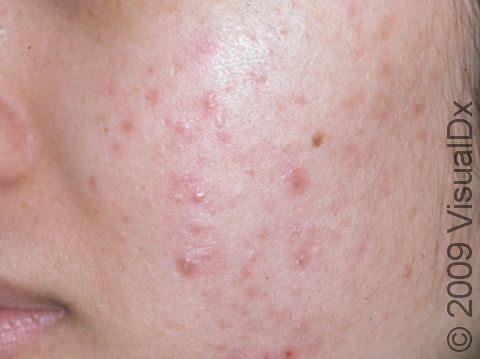
This image displays bumps, pus-filled lesions, and dark, flat pigmented marks from previous acne lesions.
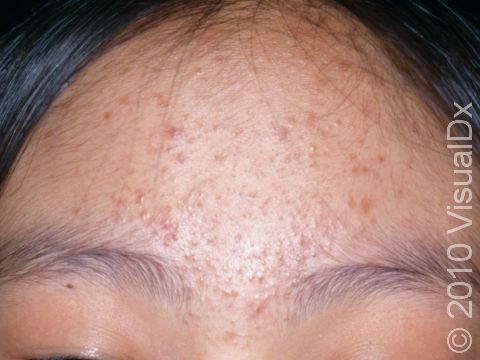
This image displays numerous whiteheads (closed comedones) and scattered acne bumps.
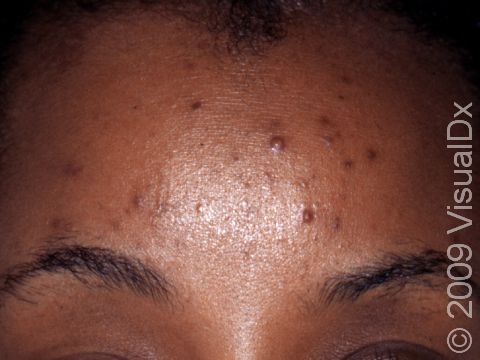
This image displays small acne pus-filled lesions as well as darker marks from previous lesions on the forehead.
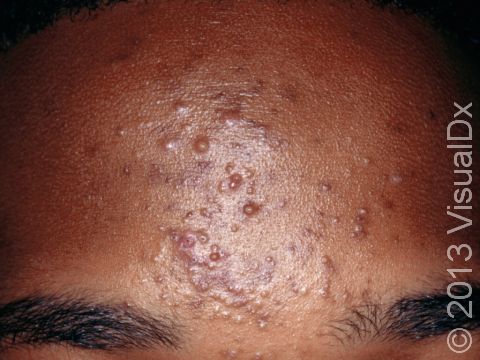
This image displays bumps, pus-filled lesions, whiteheads (closed comedones), and flat, brown marks from old lesions typical of acne.
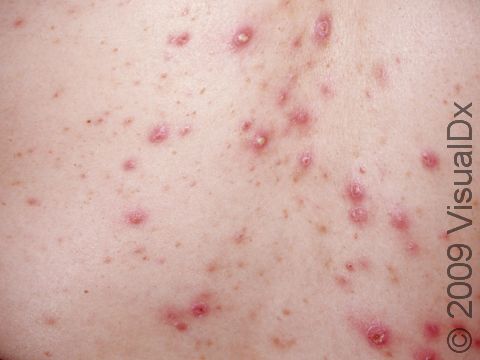
Close-up of pustules and inflammatory skin lesions of acne.
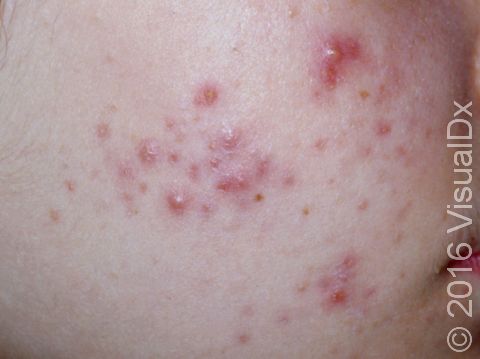
This image displays small bumps, pus-filled lesions, and residual flat, red marks typical of acne.
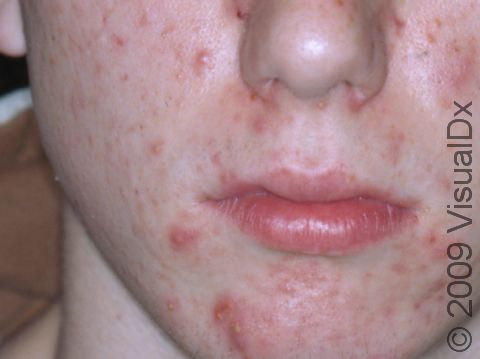
This image displays bumps, pus-filled lesions, and residual flat, red marks typical of acne.
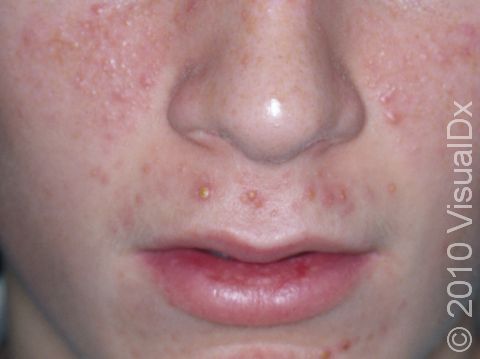
This image displays numerous pink bumps and pus-filled lesions typical of acne.
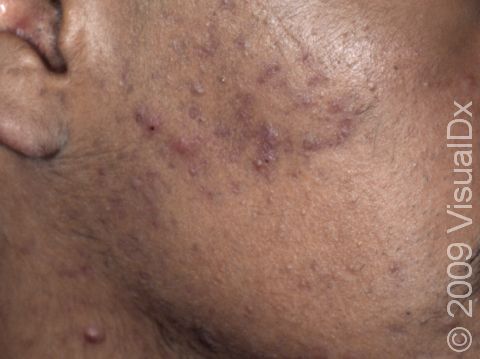
This image displays moderate inflammatory acne lesions.
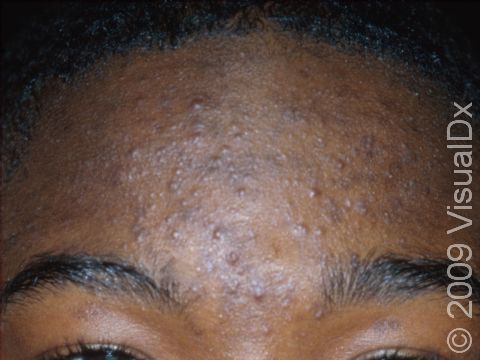
This image displays multiple bumps of inflammatory acne with faint redness of each lesion.
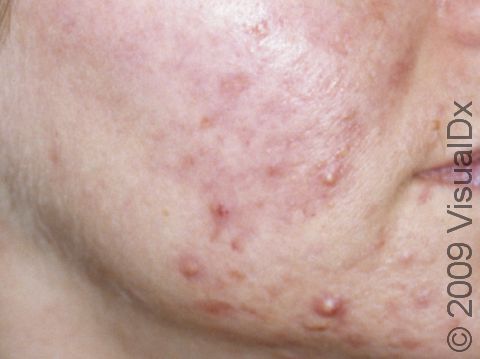
As displayed in this image, moderate and severe inflammatory acne can leave depressed scars.
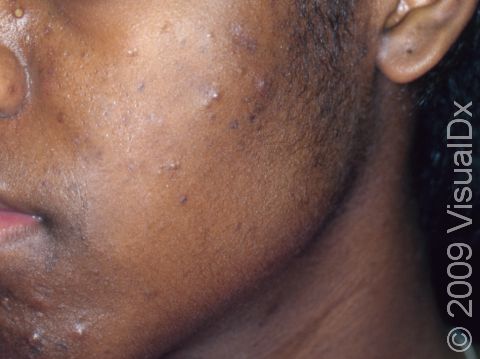
This image displays small bumps and pus-filled lesions, as well as dark, flat marks, typical of acne.
Acne (Acne Vulgaris)
Acne, also known as acne vulgaris, is a common skin condition that affects people of all ages, but it is especially common in teens and young adults.
Acne is often hereditary, meaning it runs in families. While there is no cure for acne, almost all acne can be improved by simple measures and treatments your doctor can recommend. Many people are bothered by their acne and are embarrassed to talk about it, but it is very important to discuss it with your doctor because they will be able to give you tips and prescribe products that can make a big difference.
Acne can result in scarring, so minimizing breakouts and avoiding picking at the skin is important.
Who's At Risk?
Acne vulgaris is very common, affecting most people at some point in their lives; it usually begins at puberty. Most people have acne in their teen years that goes away by adulthood. However, acne can persist into the 30s and beyond, and some adults who never had acne as a teen can develop acne for the first time. People of all races / ethnicities get acne.
Signs & Symptoms
Acne results in a variety of skin lesions. The most common locations for acne lesions include the face, neck, chest, and back, where the most sebaceous glands are located. Along the jaw line is a common location for acne in adults. Acne lesions can be blackheads (open comedones), whiteheads (closed comedones), papules, pustules, and nodules / cysts. Papules are small, smooth, solid bumps that may be pink or red in lighter skin colors or darker red, maroon, or brown in darker skin colors. Pustules are pus-filled lesions, and nodules and cysts are larger and deeper than papules.
Mild acne consists of a few papules / pustules and sometimes comedones. Moderate acne has an increased number of these lesions. Severe acne has numerous comedones, papules, pustules, and may have painful nodules / cysts.
Acne can result in permanent scars, which can appear to be depressions in the skin or as hyperpigmentation, which appears as brown, flat marks where the acne lesions were. This skin color change may be more pronounced or last longer in darker skin colors.
Self-Care Guidelines
Gentle cleansing of acne-prone areas of the skin with gentle soaps or cleansers is an important aspect of general care in acne-prone skin. Avoid irritants such as rubbing and other alcohols, abrasive scrubs, and greasy products on the skin, including on the scalp (as this may spread to the face). Products labeled “water-based” or “noncomedogenic” will help reduce clogged pores. To avoid scarring, be sure to resist picking at the lesions. Sunscreens can minimize the appearance of hyperpigmentation, and noncomedogenic, tinted sunscreens are preferred.
Keep your hair, hands, and devices such as cell phones off your face.
Over-the-counter medications:
There are a variety of over-the-counter medications that may help. These are meant to be preventive therapies and should be applied in a thin layer to the entire area on a regular basis. If applied consistently, you may see small improvements quickly, but results are generally seen after a few months. Benzoyl peroxide (the most-effective over-the-counter medication) is available in a variety of formulations (such as washes, gels, and creams) and strengths. Benzoyl peroxide tends to dry the skin, though, so if you have dry skin, use a weaker-concentration product; for oily skin, consider higher strengths. Be aware that benzoyl peroxide can bleach your clothing and towels. Peeling agents (exfoliants) such as salicylic acid, sulfur, and alpha-hydroxy acids (such as glycolic acid) can help but will also cause some dryness of the skin.
Of note:
- Acne can have significant psychological effects. Talk to your medical professional about any feelings of depression.
- Changes in diet have no proven effect on acne.
Treatments
Topical treatments for acne include one or more creams, washes, or gels, such as:
- Antibacterial agents such as clindamycin (Cleocin T), erythromycin (AkneMycin), sulfur (Liquimat, Sulpho-Lac), sodium sulfacetamide (Sulfacet R), dapsone (Aczone), minocycline (Amzeeq, Zilxi), and azelaic acid (Azelex, Finacea).
- Retinoids – vitamin A-derived products such as tretinoin (Retin-A), tazarotene (Avage, Tazorac), and adapalene (Differin).
- Clascoterone (Winlevi) – inhibits hormones that cause acne.
Oral treatments may include:
- Antibiotics such as tetracycline (Sumycin, Actisite), minocycline (Dynacin, Minocin), doxycycline (Vibramycin, Monodox), erythromycin, ampicillin (Ampi), clindamycin (Cleocin), trimethoprim-sulfamethoxazole (Bactrim), azithromycin (Zithromax), or cephalosporins.
- Oral contraceptives and spironolactone (Aldactone, CaroSpir) have been found to help regulate hormones.
- Isotretinoin (Amnesteem, Claravis), a strong drug with many side effects, for severe acne unresponsive to the above treatments.
Procedures:
- Steroid injections into any inflamed or stubborn nodules or cysts.
- Several types of laser treatments also help acne and are often used with other treatment methods; treatments are expensive, must be repeated for several months, and have variable results, though. Insurance may not cover laser therapy.
- Laser resurfacing, plastic surgery, and/or dermabrasion may help reduce the prominence of old acne scars.
- For hyperpigmentation, retinoids and benzoyl peroxide can speed up the process of lightening. Other products include topical hydroquinone, azelaic acid (10%-20%), glycolic acid, and kojic acid, and procedures such as microdermabrasion and light chemical peels can also be helpful.
Visit Urgency
If you have moderate or severe acne that has not improved enough with self-care, seek medical help.
References
Bolognia J, Schaffer JV, Cerroni L. Dermatology. 4th ed. Philadelphia, PA: Elsevier; 2018.
James WD, Elston D, Treat JR, Rosenbach MA. Andrew’s Diseases of the Skin. 13th ed. Philadelphia, PA: Elsevier; 2019.
Kang S, Amagai M, Bruckner AL, et al. Fitzpatrick’s Dermatology. 9th ed. New York, NY: McGraw-Hill Education; 2019.
Disease Groups:
Acne and Acne-Like Conditions
Last modified on June 25th, 2026 at 10:40 am
Related Articles
Not sure what to look for?
Try our new Rash and Skin Condition Finder