
Salmon Patch
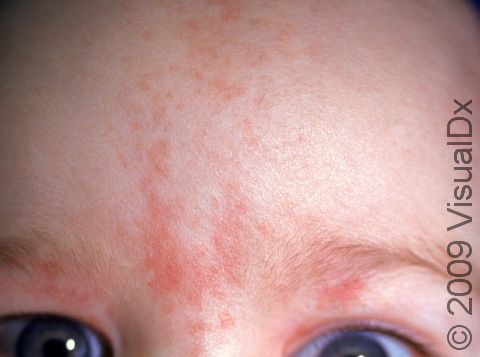
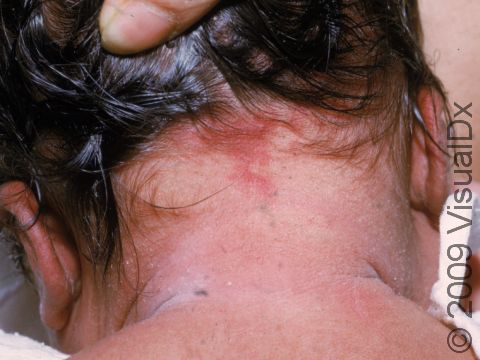
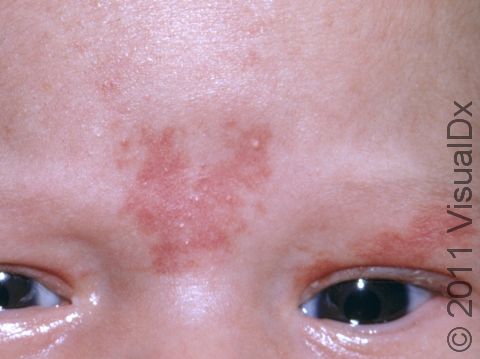
Salmon patches are birthmarks caused by expansions (dilations) in tiny blood vessels in the skin called capillaries. When a salmon patch occurs on the face, it is often called an angel’s kiss, and when it occurs on the back of the neck, it is commonly known as a stork bite. These birthmarks are very common, and approximately 7 in 10 babies will be born with one or more salmon patches. Angel’s kisses tend to fade by age 1-2 years (although some parents report that, for years, when their child cries, the angel’s kiss temporarily darkens and becomes apparent again), and stork bites tend to not go away at all but are usually covered by the hair on the back of the head. Salmon patches do not grow larger or darker and are not associated with any syndromes involving the brain or development, unlike some other birthmarks, such as port-wine stains.
Who's At Risk?
Salmon patches are very common (about 70% babies will have one or more of them) and are almost always present at birth, affecting babies of all races / ethnicities. It is thought that salmon patches do not run in families.
Signs & Symptoms
Salmon patches are pink or red, irregularly shaped patches (flat areas larger than a thumbnail) that appear on the baby’s face or the back of the neck. In darker skin colors, they may be more subtle or may appear darker red. They also sometimes occur on the trunk and limbs. On the face, they are commonly found between the eyebrows or on one of the eyelids. Salmon patches are not painful or itchy.
Self-Care Guidelines
Treat the salmon patch as you would any other skin on your baby, with careful, gentle cleansing and moisturization.
Treatments
There is no treatment necessary for salmon patches. Salmon patches on the face almost always go away on their own within a year or two. Salmon patches that persist may be treated with laser therapy of the skin.
Visit Urgency
You do not need to seek medical care for a salmon patch. However, if the skin bleeds, develops cracks, or if the area becomes darker or more raised, contact your child’s medical professional for further advice.
Trusted Links
References
Bolognia J, Schaffer JV, Cerroni L. Dermatology. 4th ed. Philadelphia, PA: Elsevier; 2018.
James WD, Elston D, Treat JR, Rosenbach MA. Andrew’s Diseases of the Skin. 13th ed. Philadelphia, PA: Elsevier; 2019.
Kang S, Amagai M, Bruckner AL, et al. Fitzpatrick’s Dermatology. 9th ed. New York, NY: McGraw-Hill Education; 2019.
Paller A, Mancini A. Paller and Mancini: Hurwitz Clinical Pediatric Dermatology. 6th ed. St. Louis, MO: Elsevier; 2022.
Last modified on June 14th, 2024 at 4:40 pm
Not sure what to look for?
Try our new Rash and Skin Condition Finder